Turning Dead Corners Into Dream Storage
Bedroom corners are strange spaces. They sit there, gathering dust, holding a lonely plant or a wobbly lamp, while the rest of the room feels cramped and cluttered. When wardrobe space is tight, that wasted corner can start to feel a bit annoying.
Corner wardrobes are a simple way to turn that awkward gap into real, usable storage. By wrapping your wardrobe neatly around a 90-degree angle, you can create a continuous run of doors and hanging space that feels almost endless, without making the room feel smaller. In this guide, we will walk through how corner wardrobes work, when they beat corner wardrobes, and how they can help you get more from every inch of your bedroom.
How Corner Wardrobes Save Space and Extend Wardrobe Runs
The big strength of a corner wardrobe is how it turns dead space into something useful. That tight angle where two walls meet is hard to furnish with standard pieces, so it often ends up with:
- Small chests that never quite fit
- Odd shelves that collect random bits
- Empty floor space that gathers dust
A purpose-built corner wardrobe fills that angle from wall to wall and from floor to ceiling. The corner unit itself is usually a little deeper than a standard wardrobe. This depth is perfect for things that are bulky or used less often, such as:
- Suitcases and holdalls
- Big winter coats
- Spare duvets and pillows
- Boxes of seasonal clothes
The real magic happens when the corner wardrobe connects two straight runs. Instead of one wardrobe on one wall and another on the next, separated by a gap, the corner section links them into a smooth L-shape. Visually, it feels like one long built-in, which keeps the room tidy and calm.
When people talk about corner wardrobes, they often mean sliding wardrobes installed on two straight walls that meet in a corner. Sliding doors are great along those long, straight stretches. The corner itself, though, is better handled with a dedicated corner unit that usually has hinged doors. That gives you much better reach right into the deepest part of the space.
Corner Wardrobe Shapes: L Shaped, Diagonal and Curved
Not all corners are used in the same way, and that is where different shapes come in. The shape you pick can change both the look of the room and how easy it is to reach your clothes.
The classic option is the L-shaped corner wardrobe. Here, you have:
- Two straight wardrobe runs, one on each wall
- A corner section that links them at a right angle
- Doors that sit along each wall, keeping the corner line sharp
This is perfect in simple, rectangular rooms. It gives you maximum hanging space along both walls and feels like one continuous system.
Another clever option is the diagonal or pentagon corner wardrobe. Instead of following both walls exactly, the front of the wardrobe cuts across the corner at an angle. From above, the layout looks like a pentagon. This shape:
- Creates a wider opening into the corner
- Makes it easier to see and reach what is inside
- Still gives a generous amount of storage depth
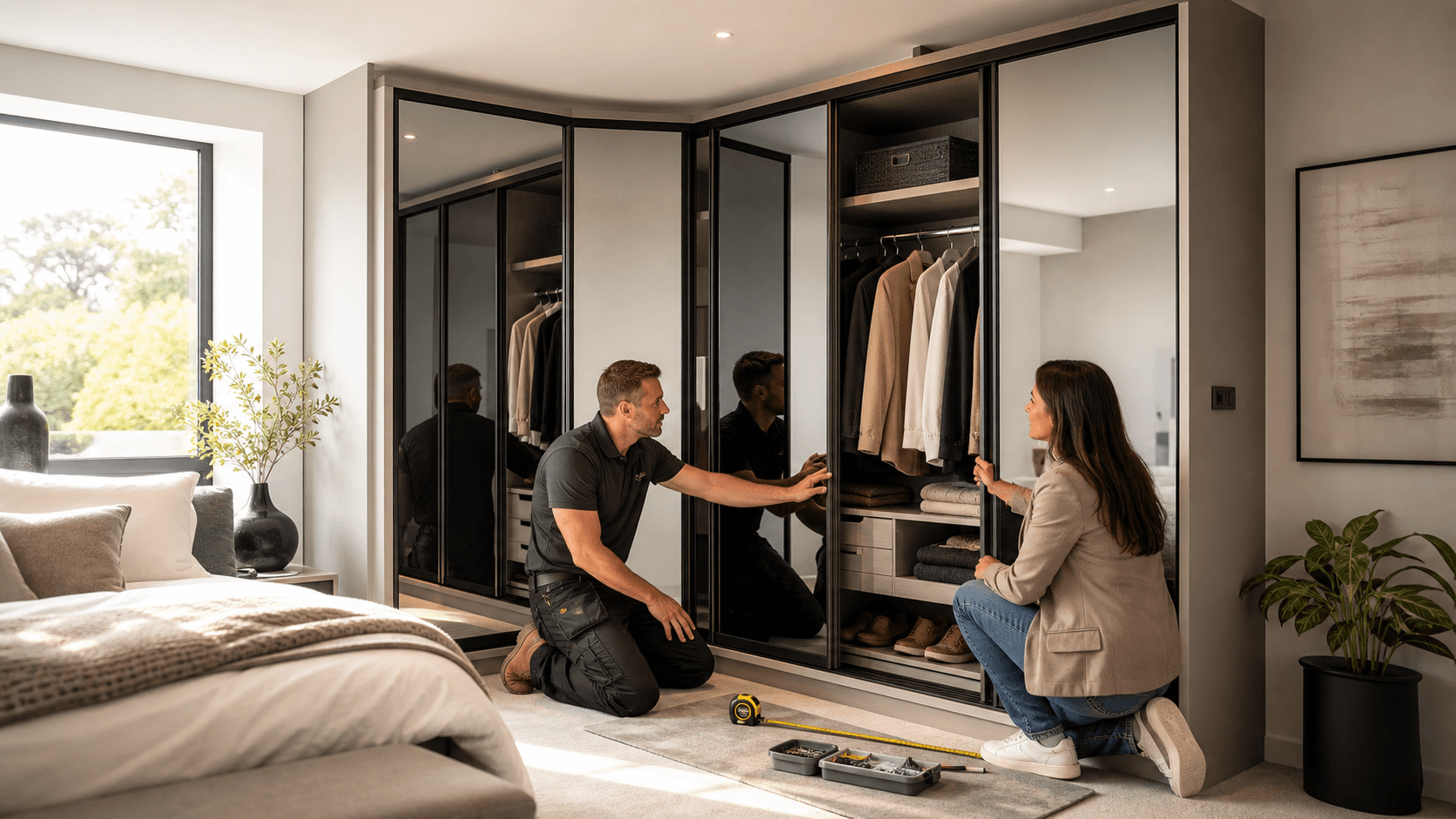
For bedrooms where you want softer lines, there are curved or radial corner wardrobes. These follow a gentle curve across the corner, so you see a smooth sweep of doors rather than a sharp angle. Curved fronts can:
- Soften the feel of a small or narrow room
- Make it easier to move around the bed
- Turn the wardrobe into a feature instead of something to hide
You can also mix shapes. For example, you might use straight runs of sliding wardrobes on each wall and add a diagonal corner unit with hinged doors for access, instead of trying to bend sliding tracks around the corner.
Why Sliding Doors Rarely Work on True Corner Units
Sliding doors are brilliant on long, straight wardrobes, especially in smaller bedrooms where there is not much space to open doors outwards. But on a true corner unit, they cause problems.
A corner unit already has a narrower opening than a straight wardrobe, because the useful space stretches deep into the angle. If you try to add sliding doors to that, the opening shrinks even more. The sliding panels need to overlap, which means one door always blocks part of the gap.
There is also the issue of how sliding doors move. Sliding systems are designed to run in straight lines. Trying to make a door slide neatly around a 90-degree bend needs complex tracks, extra parts and very careful fitting. In practice, it tends to mean:
- More to go wrong over time
- Tricky access to the deepest part of the corner
- A lot of cost for not much real benefit
Because of these access issues, we do not fit sliding doors to our corner units. Instead, our corner wardrobes use hinged or similar opening styles that swing right out of the way. You get full reach into the space, so nothing gets lost behind a panel.
Many bedrooms work best with a mix of systems. Straight runs can use sliding doors, including layouts that people might call corner sliding wardrobes, where sliding wardrobes meet near a corner. The tight corner itself is normally better handled with a dedicated corner unit that opens wide.
Interior Layout Ideas to Make Corners Work Harder
Once the outside shape is sorted, the inside of your corner wardrobe matters just as much. A deep corner can either be a clever storage zone or a black hole for lost shoes, depending on how it is planned.
A simple way to think about it is to zone the space:
- The furthest, deepest shelves are for things you do not need every day
- Hanging space should sit where you can pull clothes in and out easily
- Pull-out parts help keep the back corner from becoming wasted
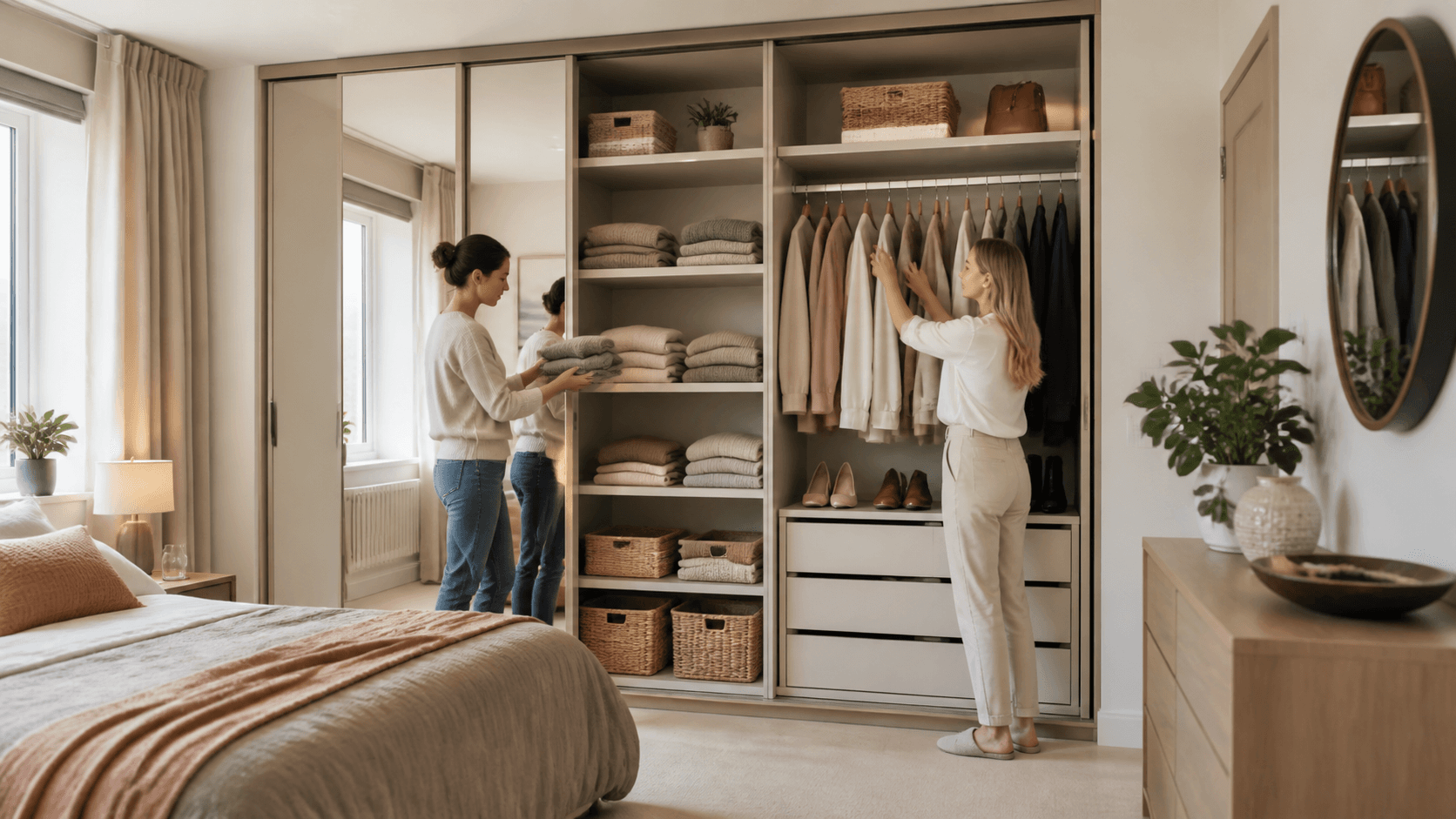
Many people use the very back of the corner for bulky or seasonal items. Overhead shelves that continue around the corner are handy for boxes and bedding. Below that, rails can run along both walls, so coats and dresses slide smoothly around the angle without gaps.
To keep everyday items close to hand, you can add:
- Pull-out baskets or drawers in the lower half
- Shoe racks near the front, not buried at the back
- Simple dividers and boxes to stop piles toppling over
Lighting is worth a thought too, especially in British homes where natural light is not always strong. LED or sensor lights inside the wardrobe make a big difference in a deep corner, so you are not digging in the dark on grey mornings.
In rooms where straight sliding or corner wardrobes form most of the storage, a well-planned corner interior turns that extra depth into something genuinely useful. It is about more than just adding volume; it is about making sure every shelf and rail can actually be used in daily life.
Choosing the Right Corner Wardrobe for Your Bedroom
At Sliding Wardrobes, we focus on modern wardrobe designs for real homes across the UK, where space is often tight and bedrooms come in all shapes and sizes. Corner wardrobes are a key part of that, because they help link sliding and hinged units into one smooth, practical run.
Sliding doors work best when they are on straight walls with enough width to let each panel move freely. Corner wardrobes are best when they are built especially for that 90-degree angle, with doors that open fully so you can use every centimetre. Often, the most effective layout is a blend of both styles, rather than trying to force sliding doors into places where they simply do not work.
If you are planning to add a corner wardrobe, it helps to measure both walls, note doors, windows, sockets and radiators, and think about where you stand when you get dressed. From there, you can start to picture how an L-shaped, diagonal or curved corner unit might turn that empty corner into part of a continuous storage wall that finally makes sense for the way you live.
Transform Your Unused Corners Into Seamless Storage
If you are ready to make the most of every inch of your room, our bespoke corner sliding wardrobes are designed to fit perfectly and look effortless. At Sliding Wardrobes, we work closely with you to create a layout, finish and internal storage that match your space and your routine. Share your measurements or book a home visit so we can suggest practical options and a clear quote. If you have questions or would like to get started, simply contact us.